
Sex Offender Searches in Bingham County
The Idaho Central Sex Offender Registry is the official public search. Idaho State Police manages it, while county sheriffs verify local registrations. The portal offers adult and juvenile database choices. That choice is not a risk tier; it selects which database is searched.
Use a name when identity is known. Use Bingham County, city, or ZIP for an area list. Use the map to examine a radius around an address, then repeat with non-map tools. Newly created addresses, homeless registrants, and people living outside Idaho but working in the state may not map as expected.
Bingham Registry Verification Office
The Bingham County Sheriff's Office at 501 N. Maple Street in Blackfoot is the local registration and verification contact. Research did not verify an appointment schedule or fee, so call 208-785-4440 before visiting. Idaho State Police receives registry information through sheriffs, IDOC, and juvenile authorities.
Alphanumeric matching can be wrong. Fingerprints provide positive identification. A public profile identifies the verifying sheriff, which helps route a correction question to the right office.
How to Search Idaho's Registry
The official registry has By Name, By City, By County, By ZIP, Map, Subscribe, and County Sheriffs routes. Name search requires only a last name; first name, city, and county narrow it. Results show fifteen per page, so a common surname can require pagination and careful comparison.
- Open the official registry and read its conditions of use.
- Select Adult or Juvenile, then choose name, city, county, ZIP, or map search.
- For an area check, select Bingham County or enter an address and choose one, three, or five miles.
- Compare photo, aliases, description, address, offense, and status before treating a profile as a match.
| Field Label | Type | Required | Notes |
|---|---|---|---|
| Last Name | Text | Yes for name search | First name is optional narrowing. |
| City / ZIP | Select | Yes for that route | Uses portal choices, not arbitrary county spelling. |
| County | Select | Yes for county route | Select Bingham County. |
| Street address / city | Text | Yes for map | State is fixed to Idaho. |
| Radius | Select | Yes for map | Exactly one, three, or five miles. |
Bingham Registry Map Limits
The registry map search tries to locate a street address first and then falls back to city and state. Icons show general proximity, not a person's exact physical location at a given moment.
The map interface shows the Bingham County radius controls.
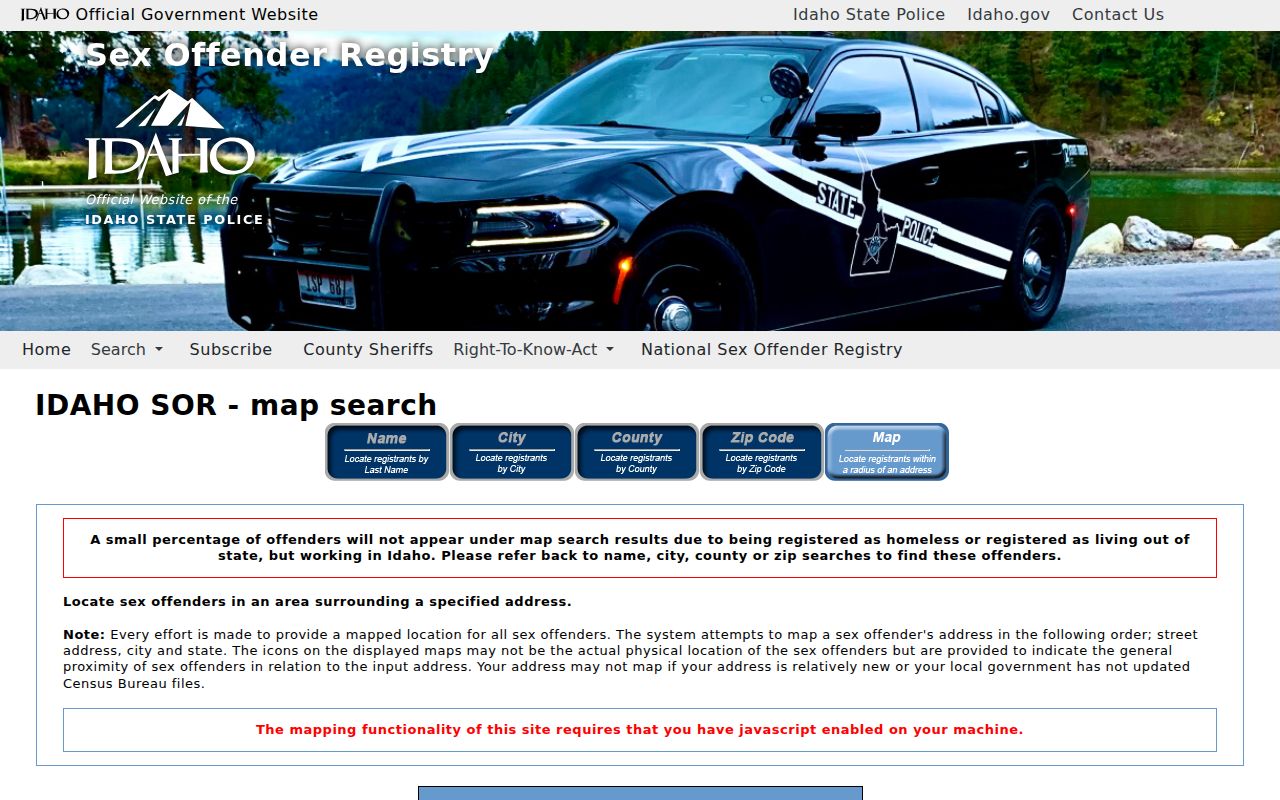
Government and Census mapping files can lag new addresses. A map-only check can miss people without a mapped home address or those who work in Idaho while living elsewhere. Repeat the search by county, city, ZIP, and name.
The search-method page displays the available official paths.
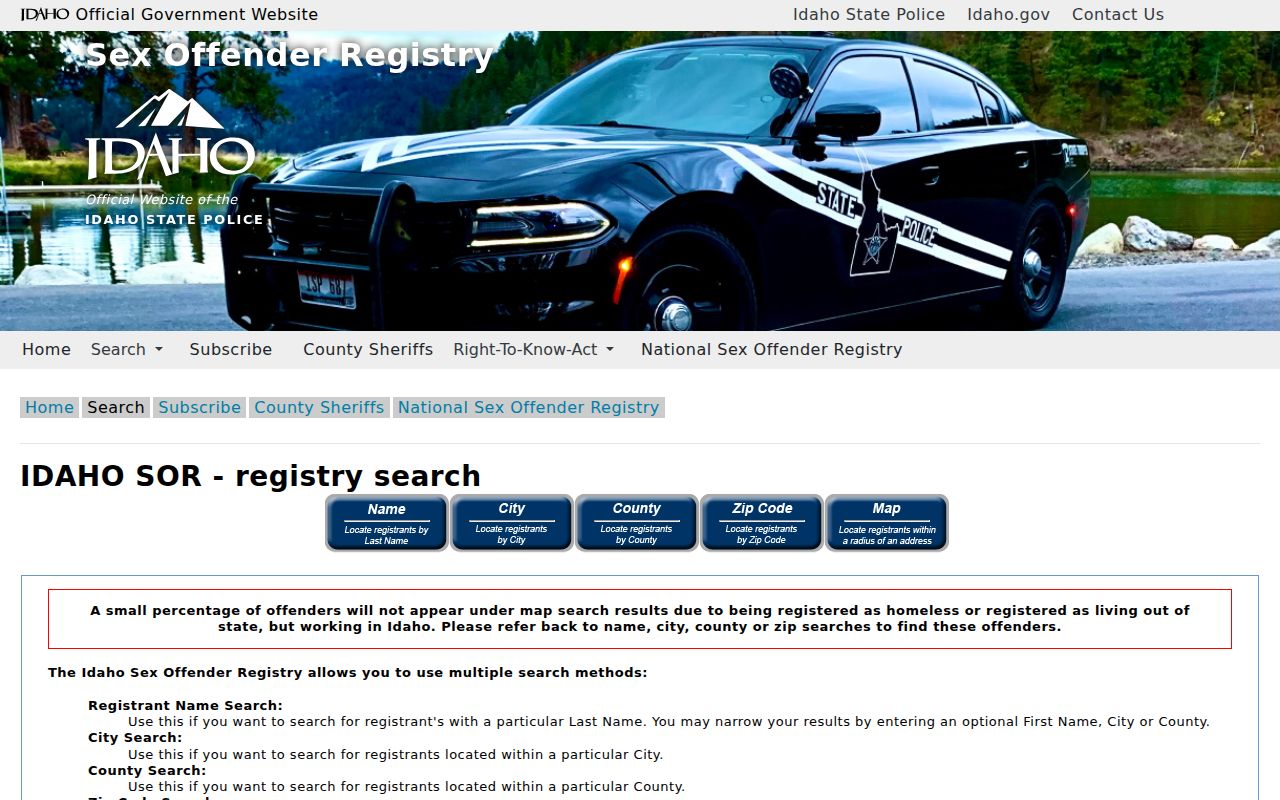
Using several methods reduces the chance that a map or spelling issue controls the result.
Inside a Bingham Registry Profile
A public Idaho profile supports identification and awareness. It does not disclose Social Security numbers, driver's-license numbers, telephone numbers, online identifiers, or additional law-enforcement-only data. Match multiple fields because a name alone can point to the wrong person.
| Name & Aliases | Reported legal name and alternate names. |
|---|---|
| Photo & Description | Image and physical identifiers used for comparison. |
| Registered Address | Reported location data, subject to mapping limits and change. |
| Offense & Statute | Registry-qualifying conviction and legal reference. |
| Classification | Violent-sexual-predator or other statutory status when applicable. |
| Registration Status | Verification and compliance information available to the public. |
Bingham County Address Alerts
The address subscription asks for street, city, ZIP, an email entered twice, and a one-, three-, or five-mile radius. It sends electronic notice when a registrant moves into or out of the selected area. It does not predict travel or report every activity.
The official subscription form shows what residents provide.
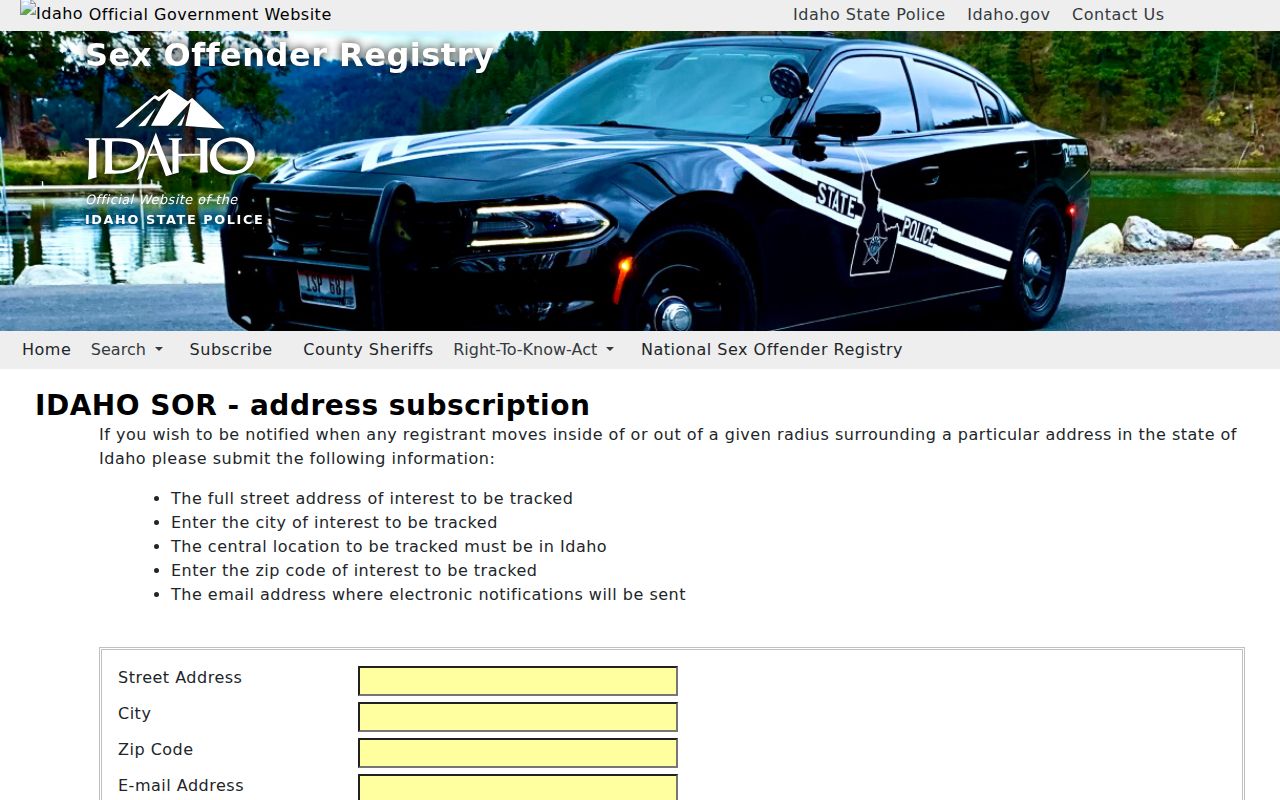
Keep the email current and review the full profile after an alert. A move notice is a prompt to check the official record, not a substitute for it.
Idaho Registration Levels and Requirements
Idaho should not be described with a federal Tier I, II, and III chart. Ordinary adult registration is generally for life. Eligible people may petition after ten years from release to the community, while aggravated offenses, recidivist status, and violent-sexual-predator designation affect eligibility. Exact duties come from the Idaho statute and sheriff.
| Idaho category | General duration | Verification |
|---|---|---|
| Other adult registrants | Generally lifetime; some may petition after ten years | Generally annual, plus required change updates |
| Violent sexual predator | Lifetime rules apply | Quarterly |
| Aggravated or recidivist status | May restrict petition eligibility | Confirm exact duty with sheriff |
Bingham Registry Record Context
The registry home page links the profile to its official purpose without centering a private person.
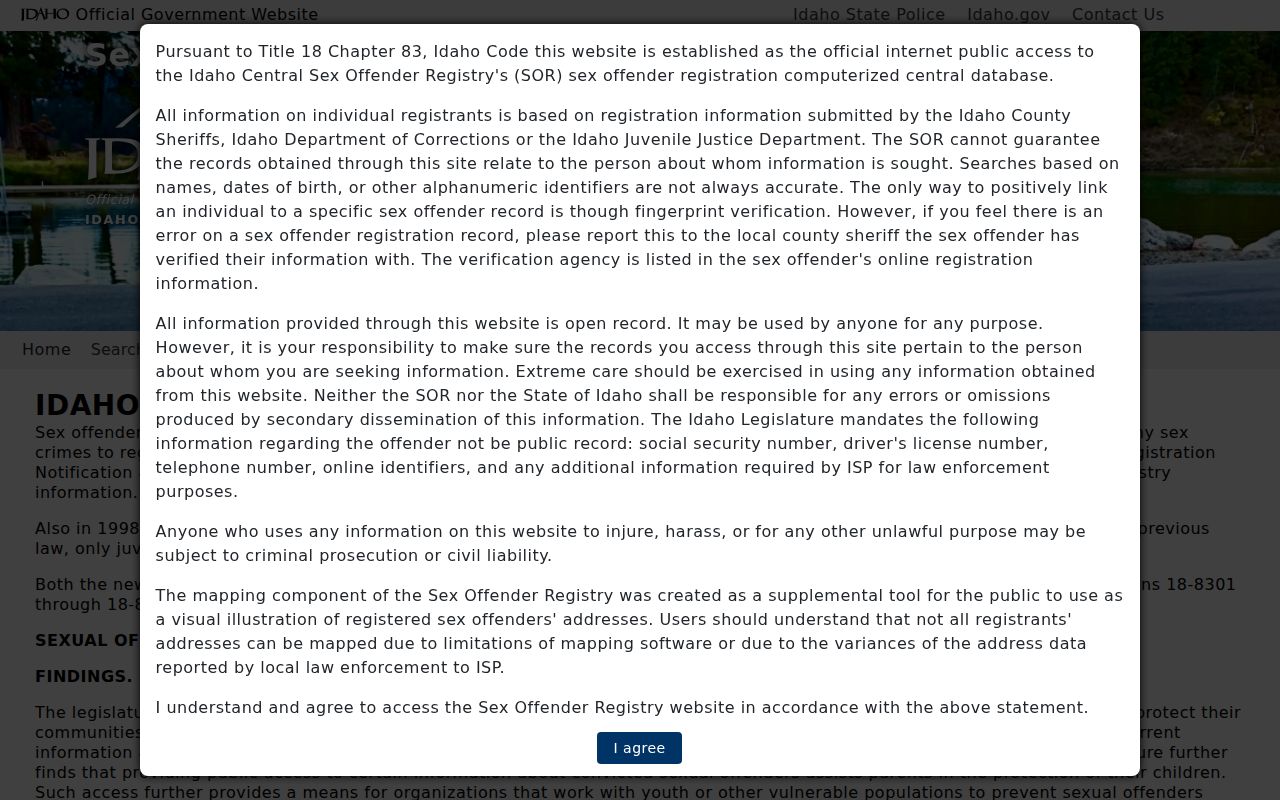
A registry profile reflects a qualifying conviction and a current registration record. It is not a live location tracker. For a question about the underlying judgment, use the court file. For a suspected reporting problem, contact the verifying sheriff or ISP's registry office at 208-884-7305 or idsor@isp.idaho.gov.
Cross-state history may require the U.S. Department of Justice national public registry search because Idaho's portal is a state system. Confirm matches through the jurisdiction that maintains them.
Public registry information also has clear limits. It does not establish where a person is at the moment of a search, and it does not include every offense or every person with a criminal history. Registration depends on qualifying law and court outcomes. A profile can change after a sheriff verifies an address, a court changes an order, or another authority transmits updated information. Save the date of a search when using it for personal safety planning, then refresh the official profile before acting on old information.
If a profile appears wrong, note the name, registry page, verifying sheriff, and disputed field. Contact Bingham County Sheriff for local address or verification data, or ISP for registry-system questions. ISP's registry office also publishes fax 208-884-7193. Do not attempt to investigate a registrant directly. Official correction routes protect both community safety and accurate identification.
Community Notification and Lawful Use
Registry data supports personal and family safety, neighborhood awareness, and informed contact with law enforcement. It does not authorize harassment, vigilantism, threats, or misuse of a public list. Idaho Code 18-8326 and 18-8413 address criminal misuse, while Idaho Code 74-120 restricts commercial use of public lists.
Use registry data lawfully: Idaho law prohibits using registry information to harass or intimidate. Threats, vigilantism, and prohibited commercial list use can carry legal consequences.
Call 911 for an emergency. Report a suspected registration issue to Bingham County Sheriff or the ISP registry office rather than confronting anyone. Preserve the URL and the specific field in question so the official custodian can review it.
Address alerts work best as one part of a broader safety plan. They report a move into or out of a chosen radius, not visits, travel, or all changes in daily activity. Search the Bingham County list from time to time, review map limits, and use official police channels for conduct that creates an immediate concern. The registry warning is as important as its search function: information must support awareness, not punishment outside the justice system. Parents and caregivers can pair these verified facts with calm, age-appropriate family safety rules.
Verification duties vary by Idaho status. Violent sexual predators verify quarterly. Other registrants generally verify annually around their birthday and after required changes. Those broad rules do not replace the exact statute or instructions from the Bingham County Sheriff. Registration can involve residence, work, school, and other reportable facts depending on the person's legal duty. A public user should avoid turning that complexity into a homemade federal tier label.
Search results also require careful identity work. Begin with last name, then narrow with first name, city, or county. Review every page when more than fifteen results exist. Compare the image, aliases, physical description, offense, and verifying agency. General proximity on a map is not proof of an exact residence point, and a shared name is not proof of identity. ISP specifically notes that fingerprints, not text matching, provide positive identification.
The Adult and Juvenile buttons select separate databases. They do not say how dangerous a person is. Likewise, a county search reports records assigned to that filter; it does not predict where someone will travel. A ZIP search can help check a mailing area, while the city and county dropdowns broaden the view. The address subscription adds notice of reported moves. These tools are strongest when used together and weakest when one result screen is treated as complete.
When the concern crosses state lines, the national public registry can point to participating jurisdictions. Open the source jurisdiction's official profile and apply its rules because registration terms differ. For a Bingham County entry, the Idaho registry and Bingham Sheriff remain the authoritative local route. Court records can confirm the underlying conviction, but they do not replace current registry verification data. Keep each record in its proper role.
Bingham Registry Corrections
Route local address and verification concerns to the Bingham County Sheriff. Send portal-system questions to the ISP registry office. State the exact profile field at issue and rely on official correction channels, not direct contact.